During the morning lineup, the boss told me I was going with them.
I was comfortable with the way things were. I wanted no part of the road trip, wherever they were going. Throughout his explanation, he pointed out the benefits, but I wasn’t listening. His office was hot and stuffy, and he went on too long trying to sell me on the idea. My Chief stood beside him, nodding in agreement, but I was deep in thought tallying the score. Was this a win or a loss? Did he even say where we were going?
Silently I had already accepted it all. I didn’t want to go but had reasoned the boss had little choice. I was the least experienced musician from my group, I was expendable, and I was single. I reassured myself that I wouldn’t have to contribute much — just help carry the gear and occasionally play my horn. Get a cue –make some noise. It was just for a few weeks.
As it turned out, my boss was a lot smarter than I had given him credit for. That morning, so long ago, I didn’t realize he was using an important management tool I would also turn to later in life: personal development through cross-training.
In a blog article on The Uncommon League, writer Paul Crosby points out the benefits of cross-training. While Crosby suggests some employees are not meant for either the challenge or opportunities of cross-training, an effective manager determines any employee’s hidden talents and skills for development, then judiciously discerns who would most likely embrace that change.
The boss must have known I would, even before I knew it myself. Yes, I was comfortable — but I had been spinning my wheels. The forced change brought about by this reassignment, and this trip not only increased my level of experience, but also opened my eyes to opportunities already available to me, but that I had been ignorantly waiting for someone to give me.
He sent me to their room to work out the details, but they were already packing up for the trip. We didn’t even rehearse. Everyone was scurrying about in the quickly emptying room, eager to get some time at home before leaving. The room seemed so much larger now, its floor littered with soda cans and coffee cups. Orphaned power cords were scattered about.
We rolled all the gear that could roll out the door and down the ramp. Dave and I walked slowly along on either side, balancing other large, heavy cases atop the heavier anvil cases. At the bottom of the ramp, he raised his eyebrows and pointed back at the door with his nose. I went back in for the small oddball cases and leftovers. In the cab of the truck, the Italian sat behind the wheel, smoking, looking back over his shoulder at us.
I realized during the drive that it had been a long time since I had been back to the Naval Air Station at Capodichino. The group I was normally with had rarely flown, driving everywhere from our NATO base in Bagnoli. We entered the airbase through a side gate I didn’t recognize, and then a smaller gate near one of the hangars alongside the tarmac. We heaped everything on top of a pallet for the military flight that was to leave the next day. The strangers I now belonged to, showed me how to untangle and rig the cargo net. One person on each corner, tugging the heavy web straps and buckling hooks onto the aluminum pallet.
During the drive back to our base, Dave explained we were going to Beirut to play for U.S. Marines deployed there. They were part of the Multinational Force in Lebanon with British and French troops. All this time I hadn’t asked any questions. Acting nonchalantly, I had tried to play it cool, but inside I was about to explode with excitement. I was escaping the routine.
My tour with the Ambassadors was to be a trip full of firsts. Suddenly, those guys were these guys. My first time on the road with this band… I barely knew them and didn’t understand their humor or topics of conversation yet. It would also be my first time traveling outside of Italy, and my first time to Beirut. The first time in a helicopter, the first time landing on a moving ship. Wait, are you kidding me?
Early the next morning, we flew in a C-130 to a small island that served as a staging area for the Navy and Marine Corps operations bound for Beirut. We arrived after nightfall and camped out under the awning of a makeshift tool shed made from a CONEX box.
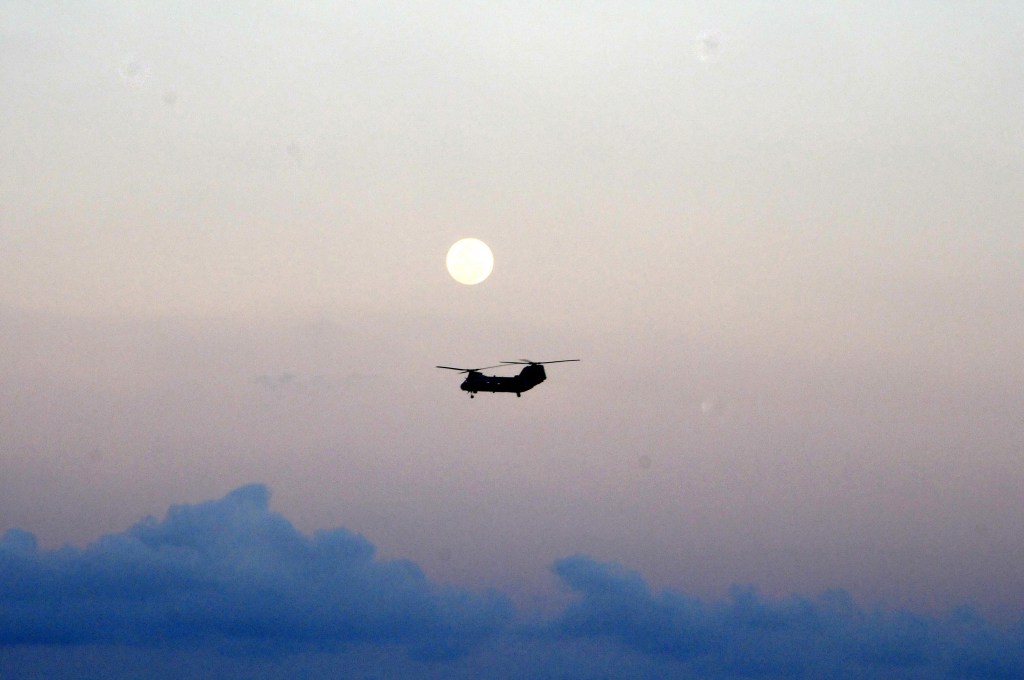
Most of us leaned against the box, using its side as a shield from the dust and the wind from other flights. Some crawled atop of the gear pallet, dragging garment bags over as makeshift blankets. We waited through the night for a helicopter out to the USS Guam (LPH-9).
During the night someone woke me up with a kick. An arm in an olive-drab flight suit passed me a heavy plastic bag. It was filled with boxed meals of cold fried chicken and light bread that another aircrew had left behind.
In the morning, we passed time smoking cigarettes or playing basketball, before finally loading a helicopter early in the afternoon. Forming a chain leading from the pallet, we quickly passed each piece of gear from our left to our right, up the line until the pallet was clear. On the ramp, two young Marines took turns receiving each armful. Guitars, drums, amps, Dave’s sax, and my trumpet. Heavy or light, large or small, each piece of gear swallowed up by the darkness of the aircraft.
The boring morning suddenly a beehive of activity. A young Marine officer introduced himself as our pilot and went through a safety brief on emergency ditching. Meanwhile, another crewmember handed us our safety vests (float coats) and cranial helmets. As I wrestled with buckles and tugged at the straps, I barely heard the pilot’s voice. “In the event of an inflight emergency…” he droned on, “…we will muster ten souls in the water, well forward of the aircraft…” What does that mean? I asked myself. I glanced at the other faces in our huddle. The comment hadn’t raised any concerns with them, so I tried harder to pay attention.
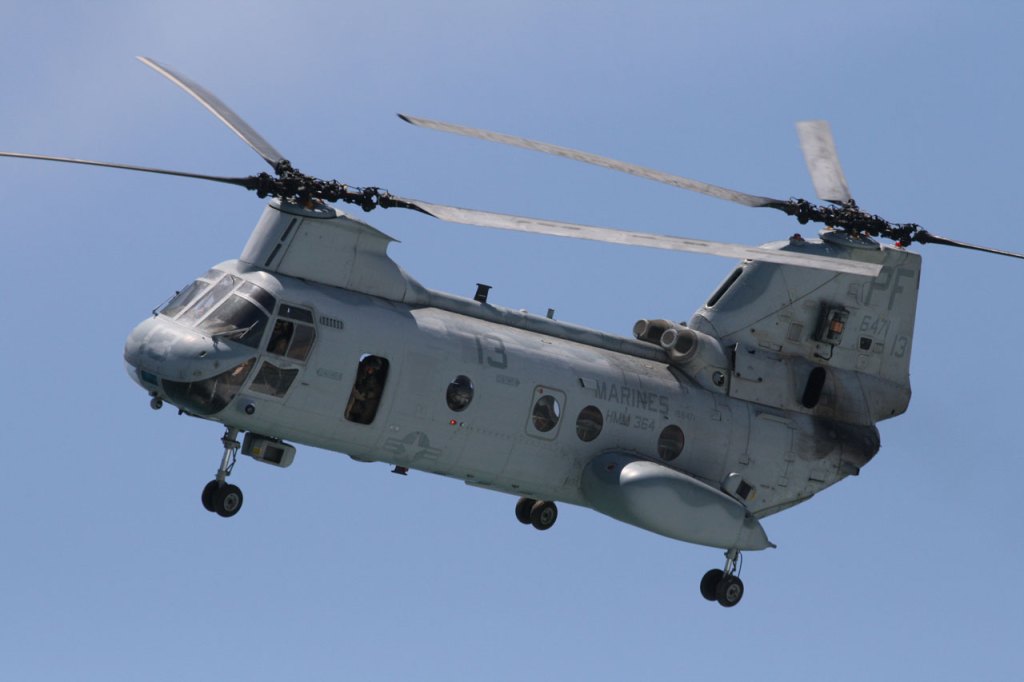
We single-filed into the gray CH-46 Sea Knight with MARINES and USS GUAM emblazoned on the side. Another first for me. The Sea Knight, with its characteristic twin-engine, three-bladed props, had been the recognized workhorse for the Navy and Marine Corps for over 20 years at this point. Someone corrected the crossed straps on my vest, then checked my helmet’s chin straps.
Pulling me close, he cracked the seal around my earpieces with the tip of his finger and loudly told me to sit down and strap in. He sat down directly across from me just as we started to lift off and hover. After a few long minutes, the crewmember in the large window saluted, and we gently rolled to one side and started to climb, leaving the island’s coastline behind us.
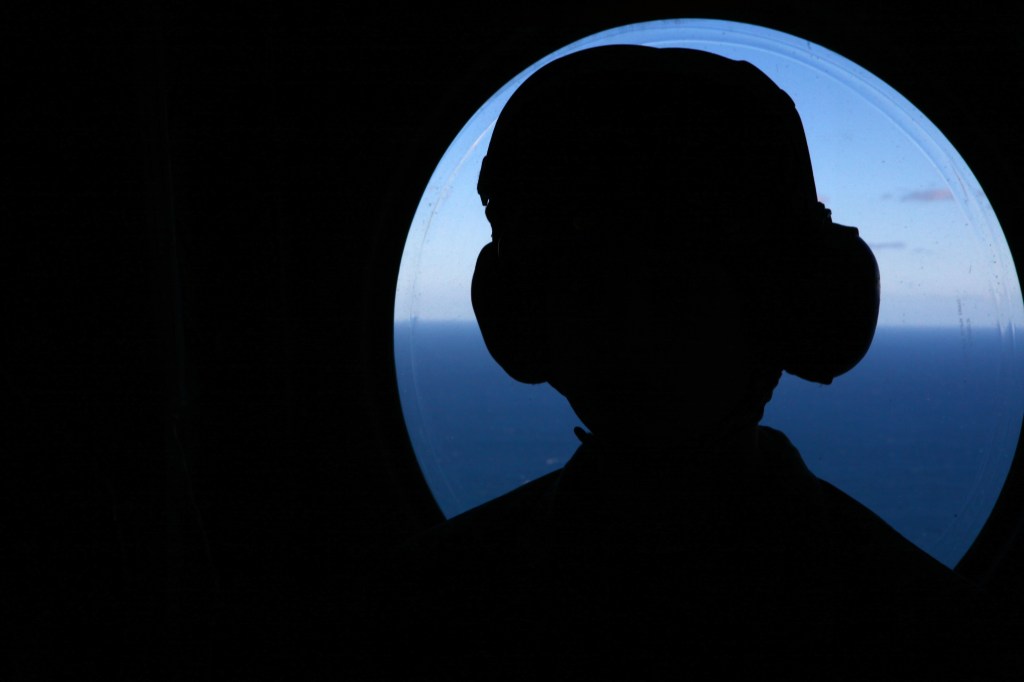
I dozed most of the flight. The steady whomp-whomp-whomp numbed my senses. While the ear protection on the helmets deadened all sound to a whisper, they seemed to amplify the sound of my own breath, and I could clearly hear my heartbeat in a wacky counter rhythm to the blade’s cadence.
After we had gained cruising altitude, the cold air kept us huddled down with our collars turned up. The only light came from four round, evenly spaced circles along both sides. I noticed the helicopter was missing some of the round Plexiglass windows — one side had glass in the first and the last, and the other glass in the middle two, and I wondered why. Was it the heat? Were they lost over the ocean? Had they been shot out?
An hour or so into the flight I saw the hydraulic fluid leak. I counted nearly ten seconds between drips, and a small puddle had started to grow on the deck just in front of me. I stared up, into the overhead and found the leak with my eyes. I watched as each drip grew from a small bubble on the line, swelling and stretching downward, finally landing with a plop. I imagined I could almost hear it land. I was getting nervous.
I motioned to the loadmaster, a Gunnery Sergeant, and pointed to the overhead where the leak was. When he couldn’t figure out what I was worried about, I stood up and shouted into his ear above the noise. I saw his face go blank as raw fear filled his eyes.
He jumped up quickly and motioned to the other Marine, pointing to the overhead. In the dim light, I saw him mouth the words “Holy Shit,” and they both started dancing wildly about in a panic. I collapsed back in my seat, checking my seatbelt and vest straps while inventorying the safety gear that came with the vest: a coil of line, a whistle, a flashlight, and a packet of dye marker that would help other helicopters find us in the water. In the water?
Suddenly, the Gunny stopped. He turned to me with a smile and pulled a sloppy wad of bubblegum out of his mouth. Winking, he carefully wound it around the leaking line. I felt like an idiot, but he grinned and gave me a thumbs-up. He crossed over to me and leaned down. “This chopper’s old,” he shouted, “we only worry when we don’t see any leaks!”
Waving his arms in improvised sign language, he motioned as if he was taking a photograph. I nodded and pulled my Nikon out of my shoulder bag. He tugged my arm and led me aft to the ramp. We crouched and he pointed down below us. Through the clouds and gathering darkness, I could make out a small shape. The shape steadily became a ship, and the ship became the USS Guam. We landed in the rain just before sunset.
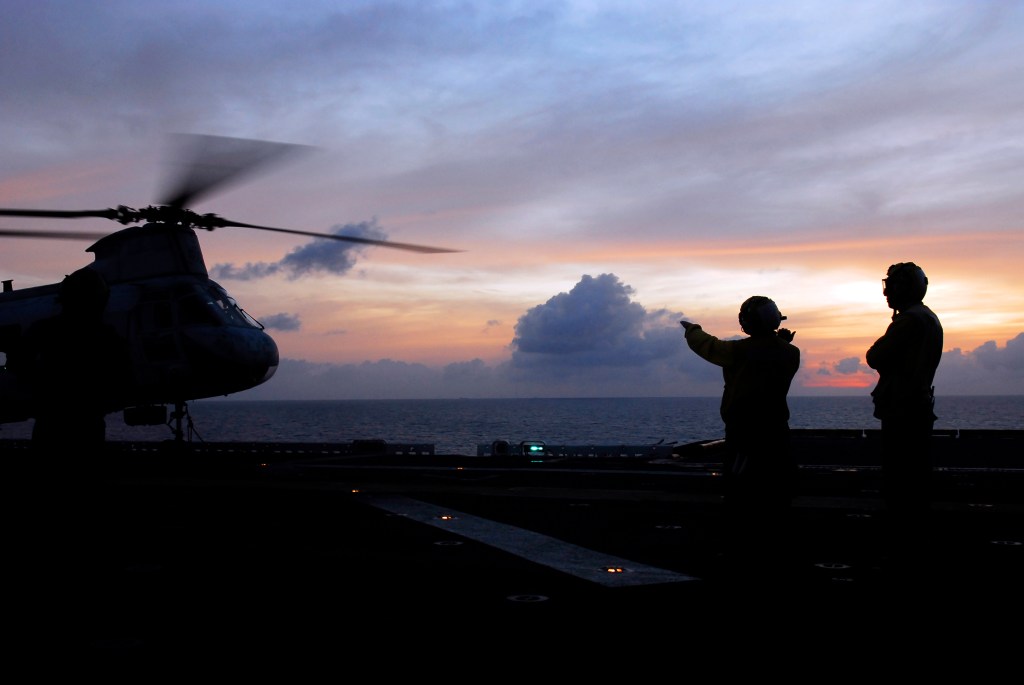
These first few days with the Ambassadors were filled with many firsts, firsts that were soon to become normal in my new life. The assignment change gave me a renewed sense of self-motivation. In this smaller group, expectations for everyone were higher, which helped me realize perhaps the most important of life’s lessons: I now knew I had the means to pursue any opportunity. If I didn’t know how to do something, I could at least figure it out.
In the coming weeks, there would be so many firsts I couldn’t yet imagine. It was late summer in 1983. I was an Ambassador, and I was off the coast of Beirut.
 Mynah Reads