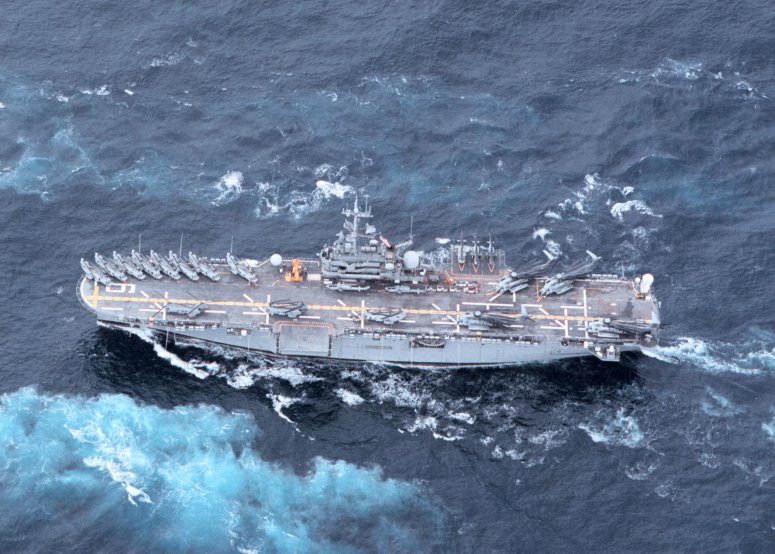
The Sea Knight took a lazy circle around the ship as it descended. The change in our speed or maybe the descent roused the rest of the band. Jim mouthed something to me, pointing out the window. I hadn’t realized that there had been another Sea Knight flying with us, and this was the first time we had seen it.
In my mind’s eye, the pair of us swooped in and gracefully landed simultaneously on the flight deck. In the real world, it was a crawl to the big ship, followed by a never-ending hover as we waited our turn. The thud of 24,000 pounds plopping to the deck, it tenses downward then relaxes. The trip of firsts. First ride in a helicopter, and first time to land on a moving ship.
Now, I was living on a ship for the first time. The GUAM was nothing like the ship I had visited when my dad was part of the crew. Partly because of my age and the ten years between visits. Stepping out onto the flight deck, I was viewing the ship now as an adult – a Sailor in my own right, instead of a civilian teenager. Head down from the noise and the heat from the engines; I followed the back in front of me. I was lost the moment I stumbled down the ladder leading from the flight deck.
My rack was in a Marine junior enlisted compartment. The rest of the band were senior to me and kept together – even the Air Force and Army members. I was not only new to their group; I was the odd-man out. I’d never been singled out before as the ‘junior man’ and did not like it.
Troop berthing, where the racks in the compartment were canvas – cot style and stacked right on top of each other, four or five high. There were no lockers for securing valuables. Grunts carried no valuables – they only brought with them what they needed for the fight.
Marines bided their time nestled in corners, playing cards or Monopoly with real money. In the back row, a few were polishing boots while watching a pair of younger men argue over a very loud game of mumblety-peg. Knives stabbed into the linoleum tiles of the deck.
I felt more than a little out of place as I searched for an empty rack. I threw my backpack up to a vacancy at the top. As I bent over and tugged on the strap of my seabag, the backpack came tumbling down on my head. I cursed and reared back for another toss but suddenly stopped when I saw an angry pair of eyes glaring in the dark, daring me to throw it again.
During chow, I noticed the rest of the band had cleaned up, even putting on fresh uniforms. Dave led me from my berthing to where they had showered and left me there. The water felt glorious, but it turned out to be a senior NCO head. The Master Chief that caught me covered in soap and shampoo handed me a stack of brown paper towels instead of letting me rinse off. He preached about personal responsibility and the importance of “water hours” while I mopped the soap off my body and out of my eyes.
Before leaving Naples, we had just switched to the dungaree uniform. The Navy had changed our working uniform from the cargo pant/chambray blue shirt back to traditional dungarees. It made no difference to me, as I had been issued dungarees in boot camp. But the band had been out in the fleet for a while and did not like the change, not buying them until the last minute. Their uniforms were still stiff and uncomfortable. The newness of their dark denim was a stark contrast to the faded and often stained dungarees of ship’s company. Pete was even wearing the wrong style chambray shirt, and I had only brought short-sleeved shirts which were not allowed at sea. Some of us wore dress corfam shoes instead of the regulation oxfords. We looked awkward and out of place and drew many stares walking around. We tried not to walk around.

 Mynah Reads
Leave a reply to Part I: Getting to the ship – duna6430 Cancel reply